

How Much Does YouTube Pay per 1,000 Views?
What YouTube actually pays creators per 1,000 views, why RPM varies so much, the official 55% and 45% revenue shares, and how to estimate your own earnings.
Quick answer: There is no fixed rate. YouTube pays creators a share of the ad revenue their videos generate: 55% of ad revenue on the watch page for long videos, and 45% of the revenue allocated to them from the Shorts Creator Pool. What that works out to per 1,000 views is called RPM, and it changes with the topic, the viewer's country and the time of year. Long-video channels commonly land somewhere in the single-dollar range per 1,000 views; Shorts usually pay cents. To put numbers on your own channel, use the free YouTube Money Calculator with the RPM from your own analytics.
Anyone who gives you one confident number for "YouTube pay per 1,000 views" is guessing. What follows is the part that is actually documented, and how to get a real figure for your channel.
What YouTube officially pays creators
These shares come from YouTube's own partner earnings page. They are the only percentages YouTube publishes, and they are percentages of revenue, not per-view rates.
| Where the money comes from | Creator's share |
|---|---|
| Ads on the watch page (long videos) | 55% of net revenue |
| Shorts ads, via the Creator Pool | 45% of the revenue allocated to the creator |
| YouTube Premium revenue allocated to Shorts | 45% of net revenue |
| Channel memberships, Super Chat, Super Stickers, Super Thanks | 70% of net revenue |
Sources: YouTube Help, "YouTube partner earnings overview" and "YouTube Shorts monetization policies" (checked October 2026).
Notice what these numbers are not: they are not dollars per view. YouTube does not pay for views. It sells ads against views, keeps its cut, and passes the rest on. If nobody bids on your audience, a view can be worth nothing at all.
RPM and CPM: the two numbers people mix up
Almost every wrong earnings estimate comes from confusing these.
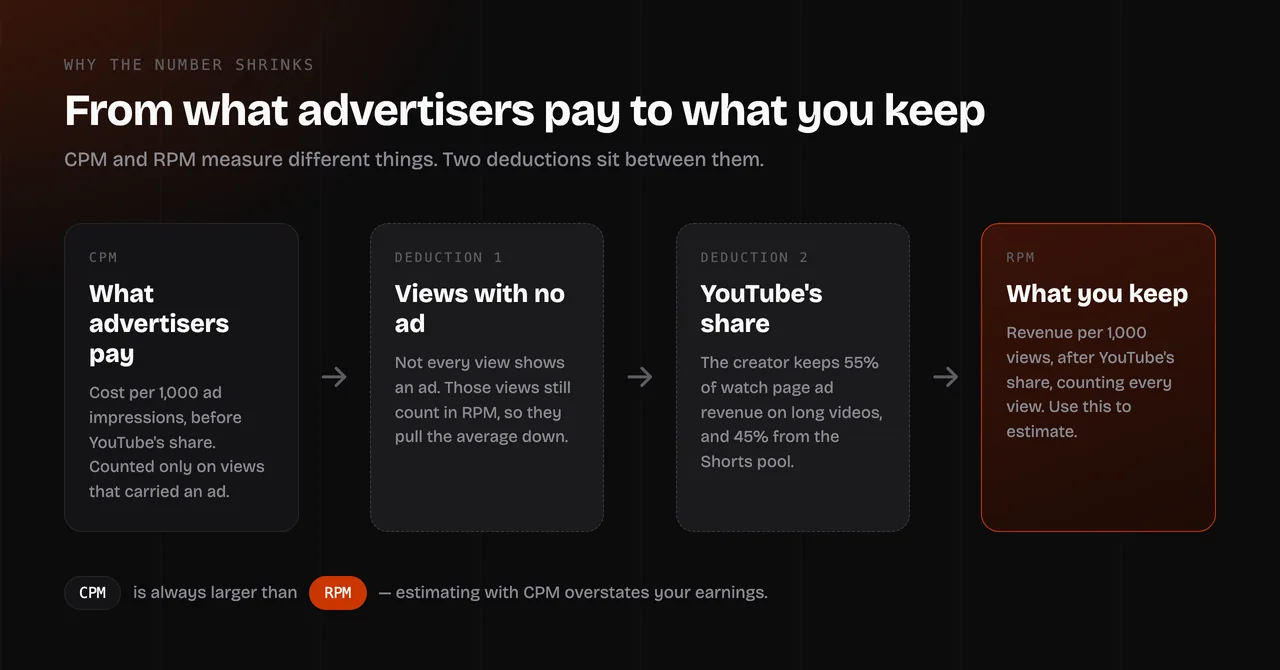
RPM — revenue per 1,000 views. What you earn per 1,000 views, after YouTube's share. It counts every view, including views where no ad was shown. This is the number to use for estimates.
CPM — cost per 1,000 impressions. What advertisers pay per 1,000 ad impressions, before YouTube's share, and counted only on views that actually carried an ad. CPM is always the bigger number.
So if you find a "$12 YouTube CPM" figure online and multiply your views by it, your estimate will be several times too high. Two separate deductions sit between CPM and RPM: YouTube's share, and all the views that never showed an ad at all.
So what is a realistic RPM?
Here is the honest answer: nobody can tell you from outside your channel. YouTube does not publish RPM benchmarks, and only the channel owner can see a channel's real revenue figures.
What can be said with confidence is which direction each factor pushes:
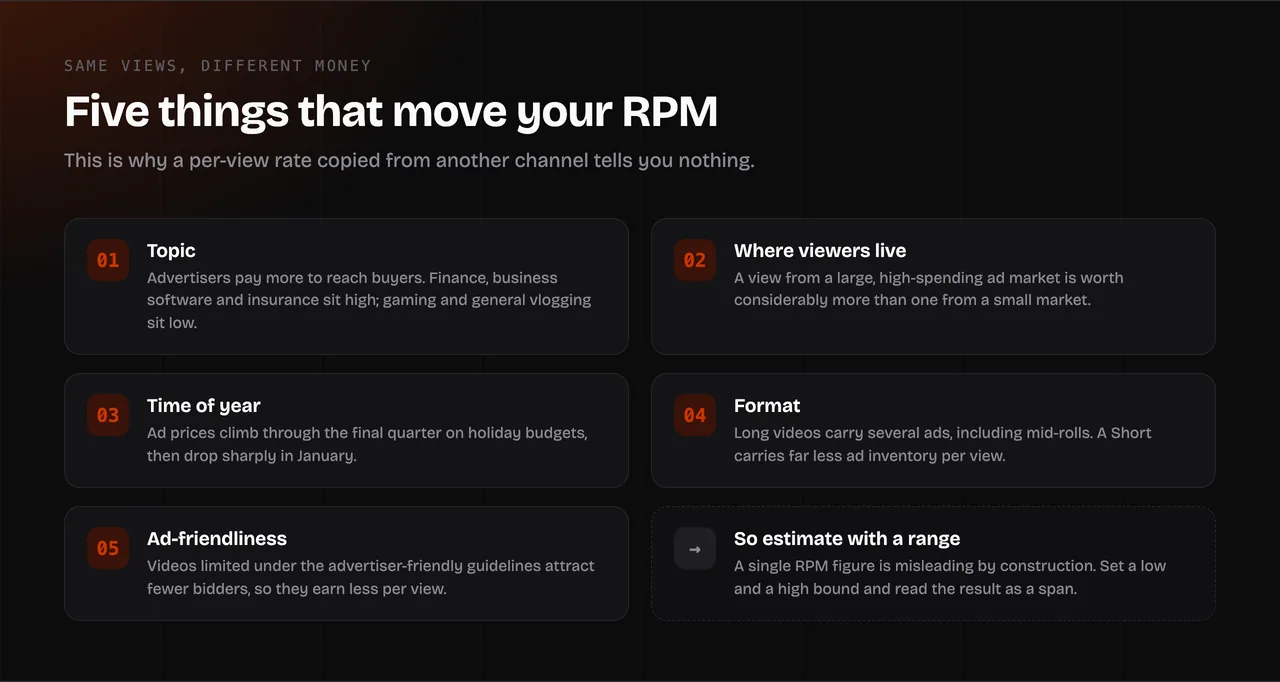
- Topic. Advertisers pay more to reach audiences that buy expensive things. Finance, business software and insurance sit at the top; gaming, entertainment and general vlogging sit lower. This is the single biggest swing factor.
- Where viewers live. A view from a large, high-spending ad market is worth considerably more than a view from a small one. A channel with a million views spread across low-CPM countries can earn less than one with 200,000 views in a high-CPM country.
- Time of year. Ad prices climb through the final quarter as brands spend holiday budgets, and drop sharply in January.
- Format. Long videos can carry several ads, including mid-rolls. A Short carries far less ad inventory per view, which is why Shorts RPMs are an order of magnitude lower.
- Ad-friendliness. Videos limited or restricted under the advertiser-friendly guidelines get fewer bidders, so they earn less per view even with identical view counts.
- Premium viewers. Views from YouTube Premium subscribers earn a share of subscription revenue instead of ad revenue, which is counted differently.
As a rough working assumption, many long-video channels report RPMs in the low single digits of dollars, and Shorts channels report cents rather than dollars. Treat that as a starting point to replace with your own data, not as a fact about your channel.
Estimate it properly: use a range, not a number
Because RPM moves around so much, a single figure is misleading by construction. Estimate with a low and a high bound instead, and read the result as a range.
- Open the YouTube Money Calculator.
- Choose Long videos or Shorts — they pay very differently, so this matters more than anything else you enter.
- Enter the views per day you want to model, or tap a preset to try 1K, 10K, 100K or 1M.
- Set a low and a high RPM. If you have your own figure from analytics, bracket it; if you don't, keep the range wide.
- Read the daily, monthly and yearly estimates, plus the table showing what 1,000 up to 10 million views would earn at that RPM.
Everything runs in your browser and nothing is sent anywhere. The output is ad revenue only — sponsorships, memberships, Super Thanks and merch sit on top of it, and for many mid-sized channels those add up to more than the ads do.
Find your real RPM
If your channel is already in the YouTube Partner Program, stop estimating and read the actual number:
- Open YouTube Studio.
- Select Analytics in the left menu.
- Open the Revenue tab.
- Read your RPM for the period you care about.
Compare RPM across different time ranges before you trust it. A single good week, or one video that happened to attract high-paying ads, will skew a short window. A 90-day or 365-day figure is a much better basis for planning.
You cannot do this for someone else's channel. Only the owner sees revenue data, so every "how much does this channel earn" figure published by a third party is an estimate built on an assumed RPM — usually an optimistic one.
How many views before you earn anything?
None of this applies until the channel is accepted into the YouTube Partner Program. For ad revenue, YouTube requires 1,000 subscribers plus either 4,000 qualified public watch hours in the last 12 months or 10 million qualified public Shorts views in the last 90 days.
A detail that surprises people: watch hours from Shorts in the Shorts Feed do not count toward the 4,000-hour threshold. If your growth is all short-form, the 10-million-view path is the one you are on, not the watch-hour one.
There is also a lower 500-subscriber tier that unlocks fan funding — memberships, Super Chat, Super Thanks and shopping — but not ad revenue sharing. The YouTube monetization requirements guide covers both tiers, the non-numeric requirements and the review process.
A change to Shorts earnings in February 2027
YouTube has announced that starting February 1, 2027, earning a share of Shorts ad revenue from the Creator Pool each month will require at least 10 million qualified Shorts views in the last 90 days. Views are measured over the 90-day period ending on the 15th of the month before the month being paid.
This is upcoming policy rather than how things work today, and it concerns eligibility to be paid from the Shorts pool each month, not membership of the Partner Program itself. If Shorts are a meaningful part of your income, check the current state of the Shorts monetization policy page rather than relying on any article, including this one.
Why two channels with the same views earn differently
| Channel | Monthly views | Likely outcome |
|---|---|---|
| Personal finance, mostly US and UK viewers, 12-minute videos | 200,000 | Higher earnings |
| Gaming compilations, globally spread audience, Shorts only | 2,000,000 | Lower earnings |
Ten times the views, less money. That is not unusual, and it is the reason per-view "rates" copied from other channels are worthless for planning.
If you want to understand why a particular video seems to do better than yours, the public signals are worth checking: the YouTube Metadata Viewer shows a video's exact publish time, duration, category and topics, which tells you a lot about the audience advertisers are bidding for.
FAQ
How much does YouTube pay for 1,000 views? Whatever your RPM is — YouTube publishes revenue shares, not per-view rates. Many long-video channels report low single-dollar RPMs and Shorts channels report cents, but the range is wide. Enter your own RPM in the YouTube Money Calculator for an estimate.
How much does YouTube pay for 1 million views? At an RPM of $1 to $5 on long videos, 1 million views works out to roughly $1,000 to $5,000 in ad revenue. The calculator shows the figure for the RPM you set, and the table there covers 1,000 up to 10 million views.
How much do YouTube Shorts pay per 1,000 views? Far less than long videos. Creators keep 45% of the revenue allocated to them from the Shorts Creator Pool, distributed by their share of engaged views in each country, which typically works out to cents rather than dollars per 1,000 views.
What is a good RPM on YouTube? Good is relative to your topic. A finance channel and a gaming channel with the same RPM are performing very differently. Compare yourself against channels in your own niche and your own past months, not against a published average.
Does YouTube pay per view or per subscriber? Neither. YouTube pays a share of the ad and subscription revenue your content generates. Subscribers matter only because they drive views, and because 1,000 of them is an eligibility threshold.
Do views from the same person count every time? Repeated views from one person can count, but YouTube filters invalid and artificial traffic, and such views are removed from both view counts and earnings. Buying views does not produce revenue.
Does RPM include sponsorships and affiliate income? No. RPM covers the revenue YouTube pays you. Sponsorship fees, affiliate commissions and product sales never pass through YouTube, so they appear nowhere in Studio's revenue figures.
Why did my RPM drop in January? Advertiser budgets reset after the holiday quarter, so ad prices fall. A drop of this kind every January is normal and is not a sign that anything is wrong with the channel.
Can I see how much another channel earns? No. Only the channel owner can see revenue. Third-party earnings figures are estimates from assumed RPMs, which is why two sites will quote wildly different numbers for the same channel.